

Seo Services

Search Engine Optimization, commonly known as SEO, is one of the most important digital marketing disciplines for businesses, publishers, online stores, professionals, and organizations that want to become visible in search engines. Although the basic idea seems simple—help a website appear higher in Google—successful SEO involves strategy, content, technology, user experience, authority, analytics, and continuous improvement.
This comprehensive guide explains everything you need to know about SEO, from the fundamentals and keyword research to technical optimization, content creation, link building, local visibility, ecommerce SEO, and performance measurement. It is designed for beginners, marketers, business owners, content creators, developers, and anyone who wants to build sustainable organic traffic.
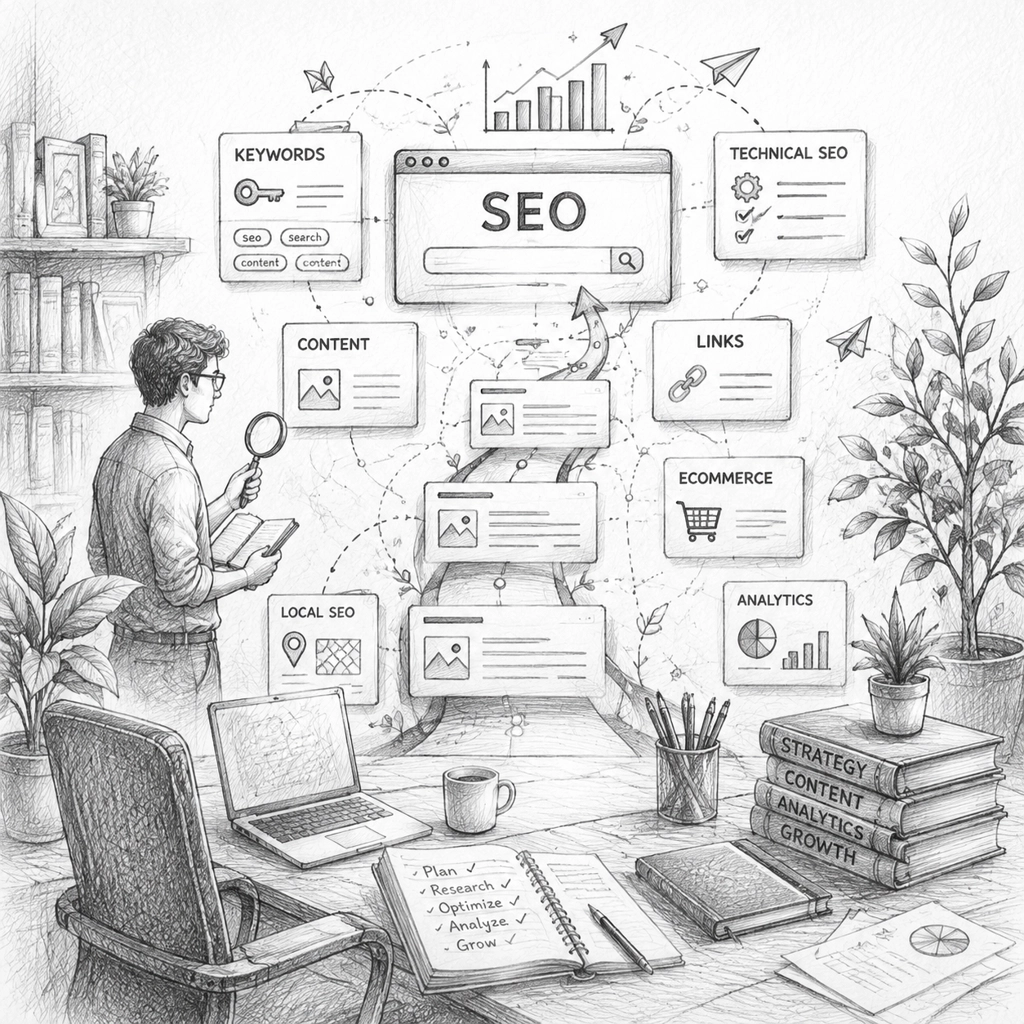
What Is SEO?
SEO, or Search Engine Optimization, is the process of improving a website so that search engines can better understand, evaluate, and rank its pages for relevant search queries.
SEO Meaning
The meaning of SEO is broader than simply ranking for keywords. Modern SEO is about helping the right audience find the right information at the right moment.
When people search for information, products, services, or solutions, search engines analyze billions of web pages to determine which results are most useful. SEO helps your website communicate its value and relevance to search engines while also creating a better experience for users.
“best industrial machine vision camera”
A successful SEO strategy should do more than place this phrase repeatedly on a page. The page should:
- Explain the topic accurately.
- Compare relevant products or technologies.
- Match the searcher’s intent.
- Load quickly.
- Be easy to navigate.
- Demonstrate expertise and credibility.
- Offer a clear next step.
This is why effective SEO combines marketing, content, technical development, user psychology, and data analysis.
Why SEO Matters for Businesses

A website may contain excellent products and services, but without visibility, potential customers may never discover it. SEO helps close the gap between what a business offers and what people are actively searching for.
The main benefits of SEO
Sustainable Organic Traffic
Paid advertising can generate immediate traffic, but that traffic generally stops when the advertising budget ends. SEO can continue producing visitors over time if your content remains useful and your website maintains its authority.
Higher Brand Credibility
Users often perceive websites that appear near the top of organic search results as more credible. Ranking prominently does not automatically prove that a business is trustworthy, but it creates an important first impression.
Better User Experience
Many SEO improvements also improve usability. Faster pages, clearer navigation, mobile responsiveness, descriptive headings, and accessible content benefit both users and search engines.
More Qualified Leads
SEO allows businesses to target specific problems, products, services, industries, and locations. A visitor who searches for “technical SEO consultant for SaaS companies” is likely more valuable than a visitor who arrives through a broad, unrelated term.
Long-Term Competitive Advantage
A strong content library, technically healthy website, and authoritative backlink profile are difficult for competitors to replicate quickly. SEO therefore becomes a strategic asset rather than a short-term marketing campaign.
How Search Engines Work
Search engines discover, understand, evaluate, and rank web pages through a continuous process. SEO becomes easier to understand when you see how these stages work together.
Crawling
Search engines use automated programs, often called crawlers or bots, to discover web pages. These crawlers follow links, inspect sitemaps, and revisit known URLs to identify new or updated content.
- Incorrect robots.txt rules
- Broken internal links
- Server errors
- Poor website architecture
- Excessive URL parameters
- JavaScript rendering problems
- Pages blocked by authentication
- Orphan pages without internal links
Indexing
After crawling a page, a search engine evaluates whether the page should be stored in its index. A page must be indexed before it can normally appear in search results.
- Duplicate content
- Very low-quality pages
- Thin or unhelpful content
- A noindex directive
- Difficult-to-render pages
- Nearly identical URLs
- Content irrelevant to users
Ranking
When someone performs a search, the search engine evaluates indexed pages and orders them according to relevance, quality, usability, authority, and many other signals.
Search engines do not use one simple formula. Their systems are complex and continuously updated. The safest approach is to create genuinely useful content and maintain a technically reliable website.
The Main Types of SEO
SEO is a connected system of practices that improves how search engines discover, understand, trust, and present your website.
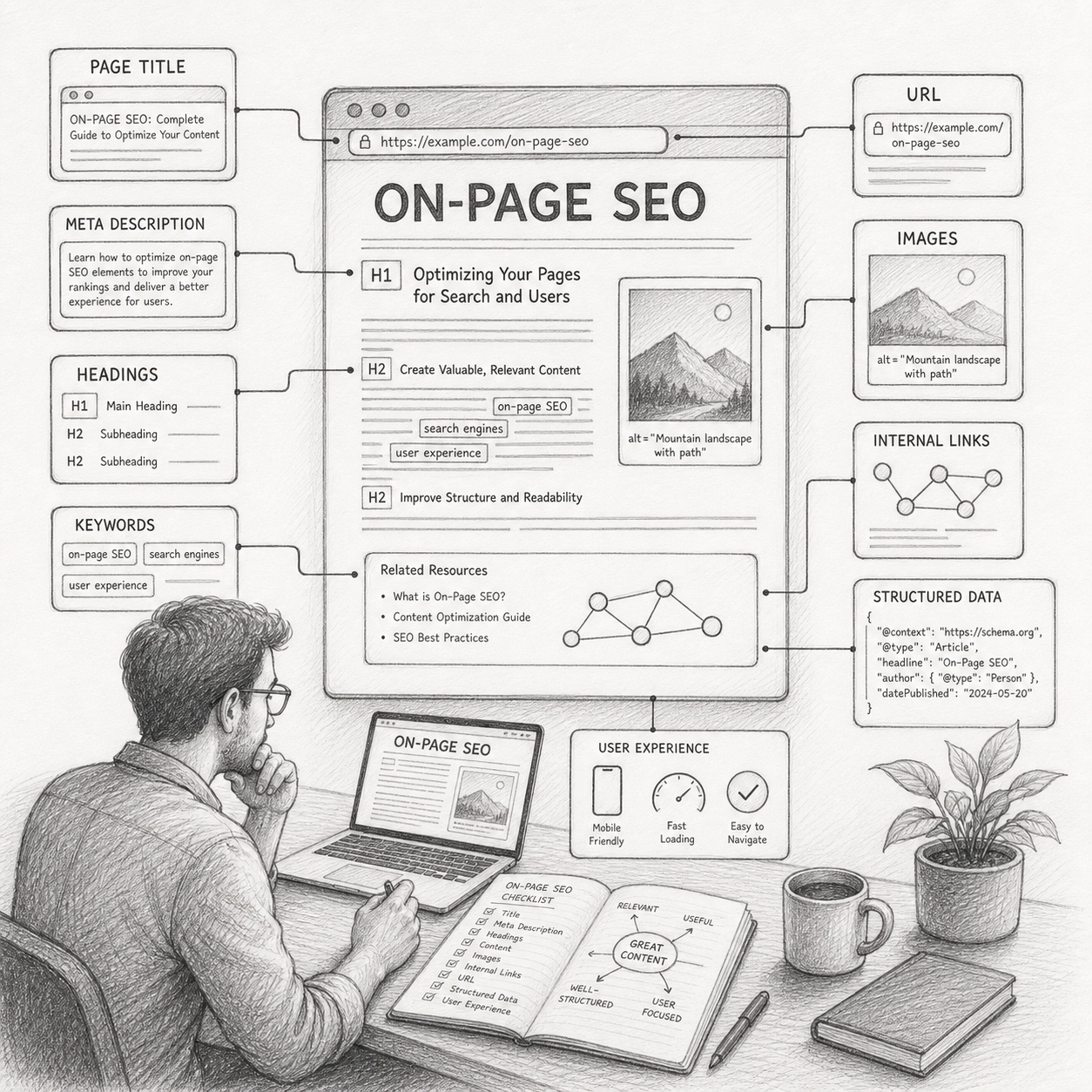
On-Page SEO
On-page SEO focuses on the elements within individual web pages. Its purpose is to make a page understandable, relevant, useful, and attractive to both users and search engines.
Make every page easy to understand before trying to make it rank.
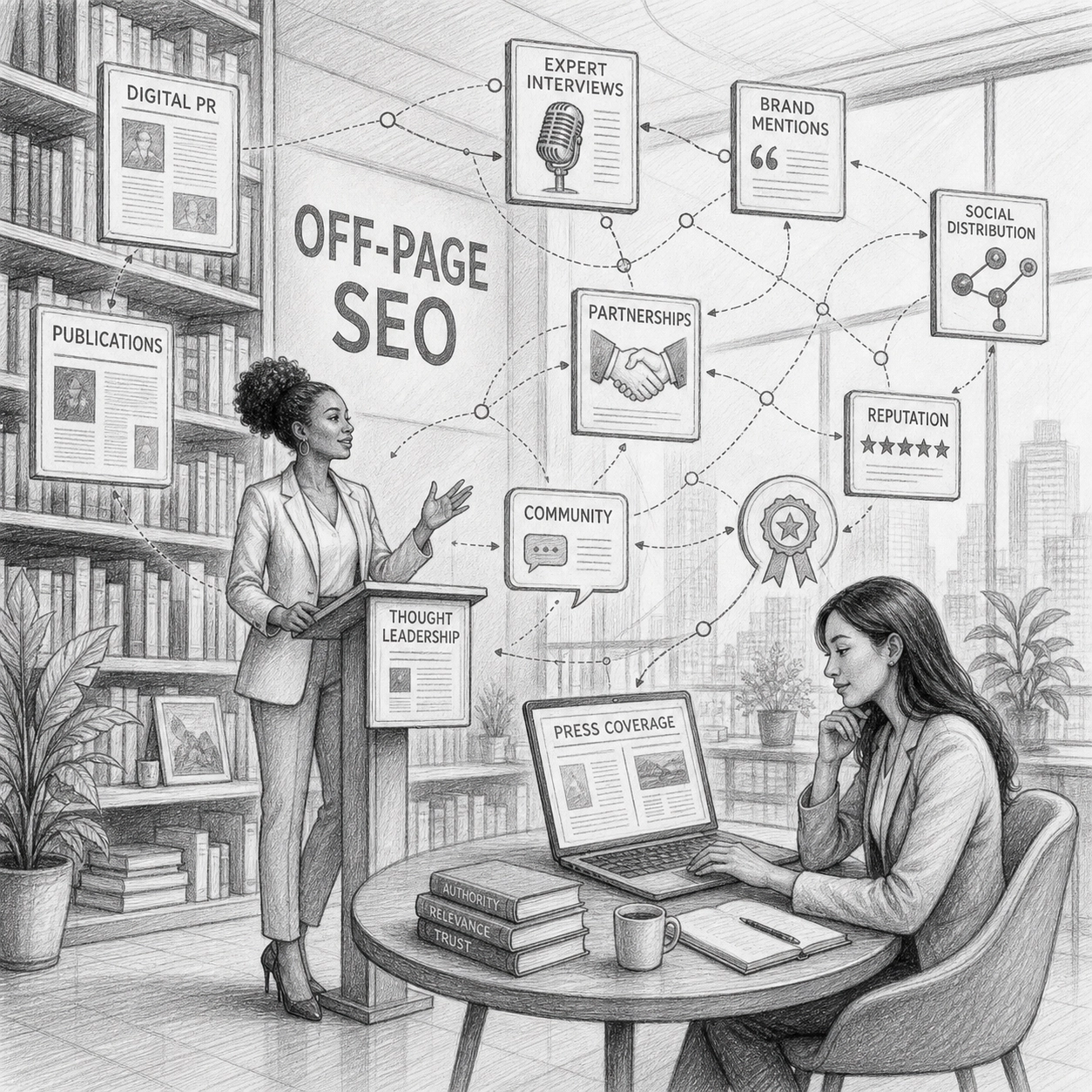
Off-Page SEO
Off-page SEO includes activities that take place outside your own website. High-quality backlinks, brand mentions, and external recognition can strengthen a website’s perceived authority.
Authority is earned when relevant and credible sources recognize your value.
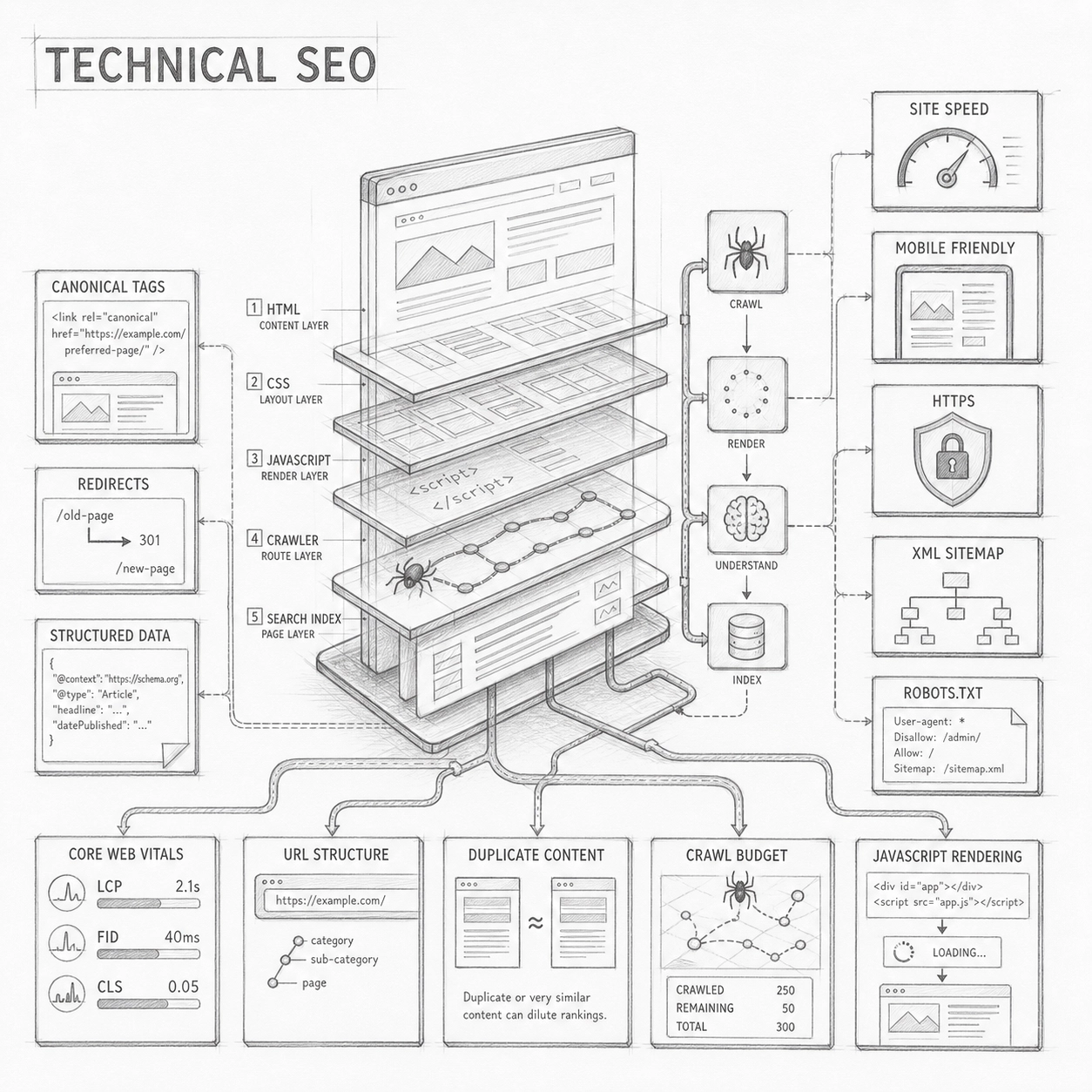
Technical SEO
Technical SEO focuses on the infrastructure and architecture of a website. It helps search engines crawl, render, understand, and index pages efficiently.
Excellent content cannot perform if search engines cannot access or understand it.
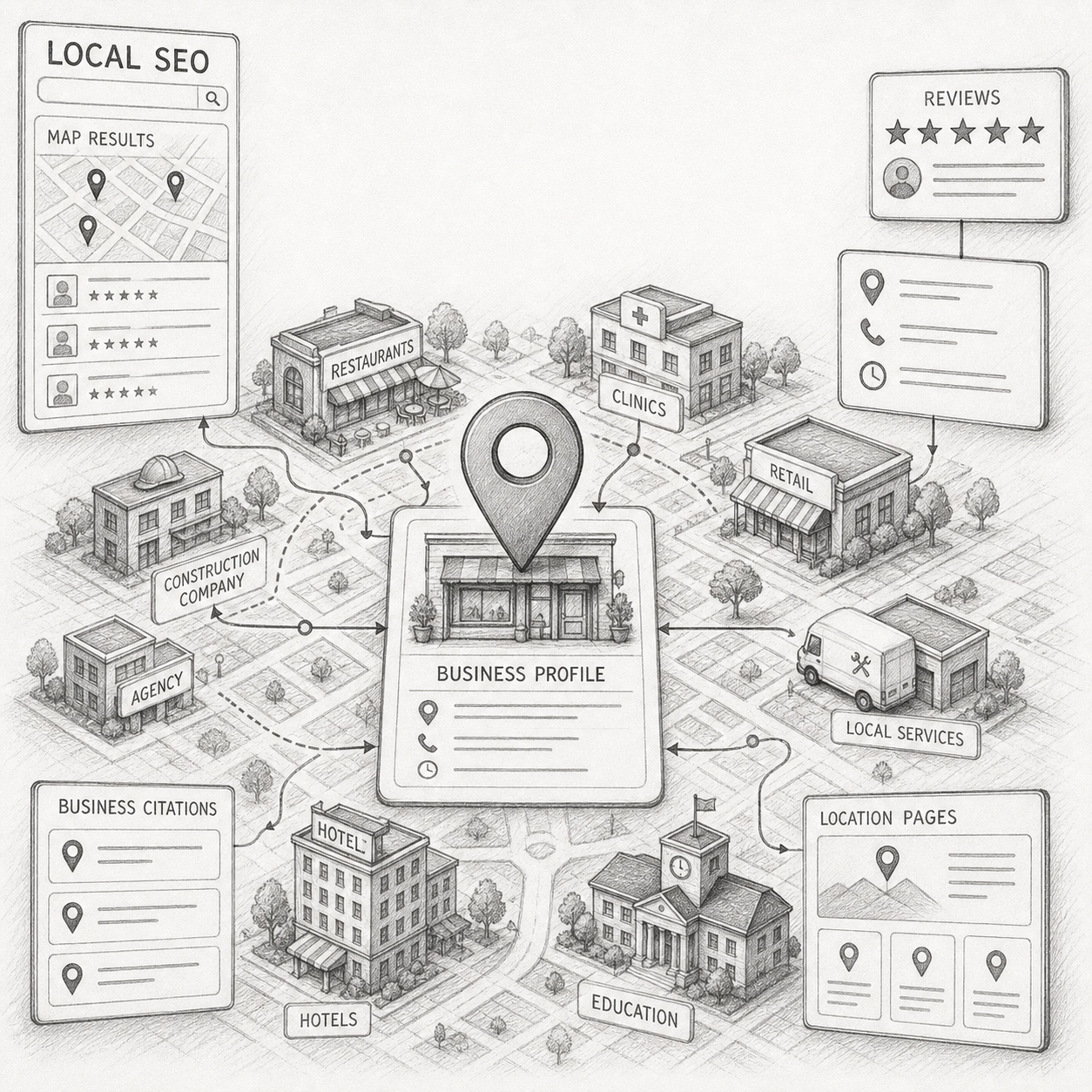
Local SEO
Local SEO helps businesses appear in location-based searches, map results, and local search features. It connects user intent with a specific place, service area, or physical business.
Local relevance transforms search visibility into real-world visits.

Ecommerce SEO
Ecommerce SEO focuses on product pages, category pages, filters, product variations, reviews, inventory, and purchase-related search intent. Ranking is valuable, but the ultimate goal is qualified revenue.
The best ecommerce traffic is traffic that can become qualified revenue.
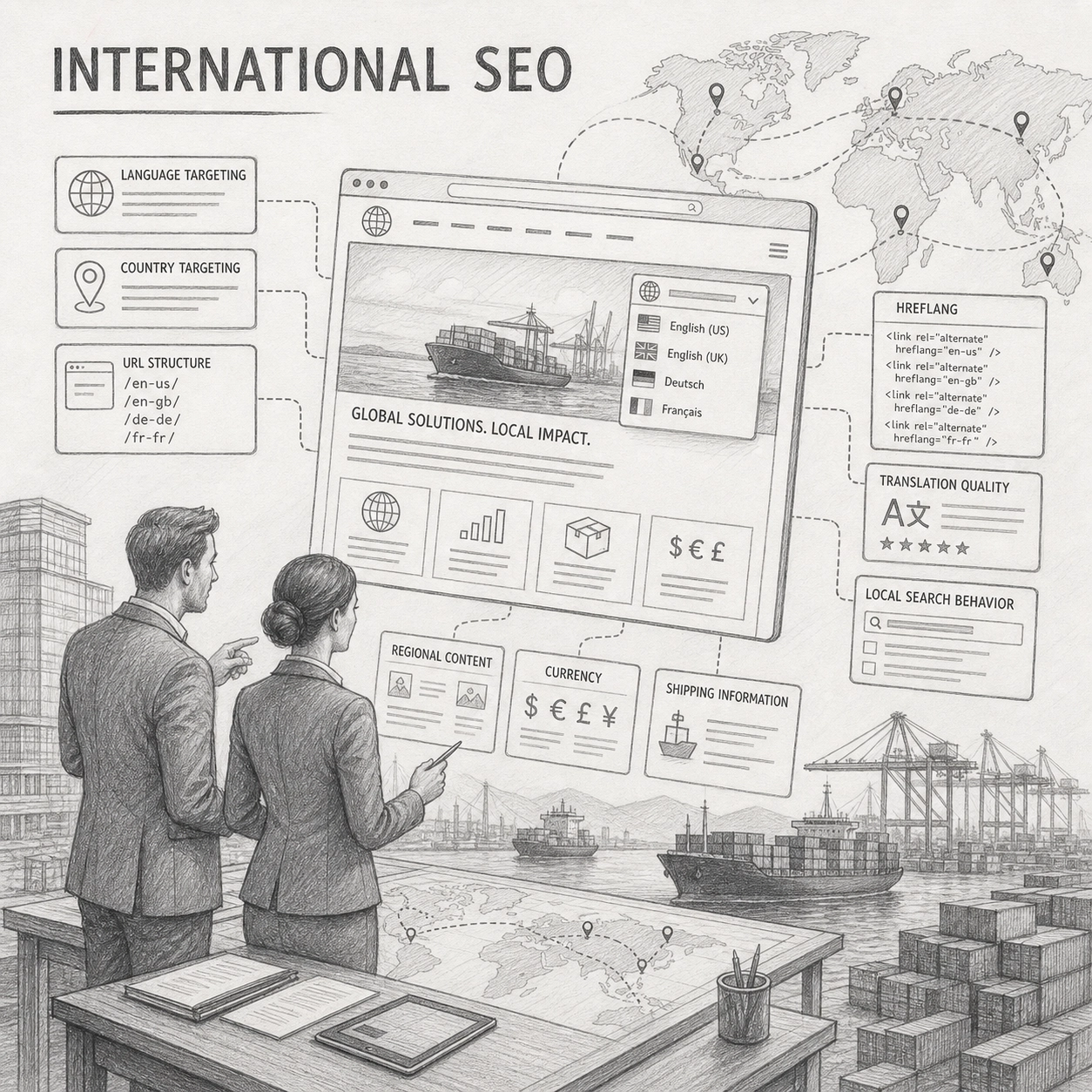
International SEO
International SEO helps a website target users in multiple countries or languages. It requires more than direct translation because search behavior, commercial expectations, and cultural context vary between markets.
Successful international SEO requires cultural and commercial localization—not literal translation.
Strong SEO comes from combining these areas instead of treating them as isolated tasks. A technically accessible website, useful content, external authority, and clear audience targeting work together to build sustainable search visibility.
Building an Effective SEO Strategy
A structured SEO strategy connects business goals with search behavior, useful content, technical improvements, and measurable outcomes.
Define Business Objectives
SEO should support a measurable business objective—not just generate visits or improve rankings.
Without a clear objective, SEO often optimizes vanity metrics that look impressive but do not create business value.
Identify Your Audience
Different audiences use different terminology, search different queries, and need different levels of technical explanation.
Audience research transforms generic content into a precise answer for a real person with a specific problem.
Analyze Competitors
The goal is not to copy competitors. It is to discover where you can be clearer, more useful, more specialized, or more trustworthy.
What can your website explain or solve better than the current search results?
Create Topic Clusters
Topic clusters organize related content around a central pillar page and help users—and search engines—understand topical depth.
Vision Systems Central topic
Cameras
Systems
Selection
Detection
Barcode
Inspection
Integration
Internal links connect related knowledge and create a clearer topical structure, which strengthens navigation and authority.
Keyword Research
Keyword research is the process of discovering the words and phrases people use in search engines. The most valuable keyword is the one that attracts the right audience at the right stage of the buying journey.
Types of Keywords
Short-Tail Keywords
1-2 words. High volume, ambiguous intent, extreme competition.
SEO
machine visionLong-Tail Keywords
3+ words. Specific, lower volume, clear search intent, easier to rank.
best technical SEO tools for ecommerce
machine vision system for defect detectionBranded Keywords
Queries containing a brand, company, or proprietary product name.
Google Search Console
Basler cameraNon-Branded Keywords
Generic searches describing problems, industries, categories, or services.
industrial camera supplier
best SEO audit toolsInformational
User wants to learn or understand. Needs educational guides.
"what is technical SEO"Navigational
User wants to find a specific page. Needs direct access links.
"Google Analytics login"Commercial Investigation
User is comparing options. Needs reviews, tables, and comparisons.
"best machine vision camera"Transactional
User is ready to buy or hire. Needs clear landing pages and CTAs.
"hire an SEO consultant"Opportunity Framework
Analyze a keyword by checking the criteria below to see if it is a viable target.
Creating High-Quality SEO Content
High-performing content is not about producing more words. It is about solving a real problem better, more clearly and more completely than competing pages.
Characteristics of Good SEO Content
Quality content combines accuracy, relevance, usability and business value. Every characteristic below contributes to a stronger user experience.
Accuracy is the foundation of trust. If the information is unreliable, even excellent design and optimization cannot create sustainable performance.
Choose the Right Content Format
Search intent determines the format. The best content type is the one that makes the user's next decision easier.
Content Depth Versus Content Length
More words do not automatically create more value. The objective is to deliver the right amount of information with the least possible friction.
Focused content can outperform longer content.
A focused 1,000-word page may perform better when it directly satisfies the user's question and provides a clear next step.
Build a Structure That Guides the Reader
A strong structure reduces cognitive load and helps both users and search engines understand the purpose of the page.
SEO Content Writing as a Dual-Optimization System
Effective SEO writing satisfies two audiences at once: the human reader and the search engine.
Understand the audience.
Strong content begins with a precise understanding of the reader's context, problem, knowledge level and expectations.
On-Page SEO Optimization
Every visible and structural element on a page should help users understand the topic, trust the information and take the next step.
Page Title
The page title is one of the strongest signals for explaining the subject of a page and setting the right expectation.
- Clearly describe the page
- Include the primary keyword naturally
- Communicate a clear benefit
- Be unique and specific
- Avoid unnecessary repetition
Meta Description
A meta description summarizes the page in search results and can influence whether the right user chooses to click.
- Summarize the user benefit
- Include the target topic naturally
- Match the actual page content
- Encourage a relevant click
- Avoid misleading claims
Headings
A logical heading hierarchy makes content easier to scan and clarifies topical relationships for users and search engines.
- Use one clear H1 heading
- Organize major sections with H2
- Use H3 for supporting subsections
- Keep the hierarchy logical
- Avoid repetitive or decorative headings
URL Structure
A clean URL helps users understand the page destination before they click and makes the site architecture easier to interpret.
- Keep it short
- Make it descriptive and readable
- Keep the structure stable
- Avoid unnecessary parameters
- Use meaningful words instead of numeric IDs
Keyword Placement
Use the primary keyword where it supports clarity and relevance, never as a repetitive formula applied to every sentence.
- Page title
- Introduction
- Relevant headings
- Readable URL
- Image alt text when appropriate
- Conclusion and internal anchor text
Images
Images should support the topic, load efficiently and remain understandable for users who rely on assistive technologies.
- Use relevant images
- Compress files properly
- Serve the correct dimensions
- Use descriptive file names
- Write meaningful alt text
- Use modern formats such as WebP when appropriate
Internal Linking
Internal links help users discover related content and distribute authority throughout the website.
- Connect related pages naturally
- Support user navigation
- Distribute topical authority
- Use descriptive anchor text
- Link to genuinely useful resources
Technical SEO
Technical SEO creates the foundation on which all other SEO activities depend.
Website Crawling and Indexing
Make sure important pages can be discovered, crawled and indexed correctly by search engines.
- Crawlable and indexable pages
- Internal linking is available
- Included in the XML sitemap
- No accidental noindex tags
- Correct HTTP status code
XML Sitemap
An XML sitemap helps search engines discover important URLs across large or complex websites.
- Large websites
- New websites
- Complex architectures
- Ecommerce websites
- Frequently updated content
Robots.txt
Robots.txt gives crawler instructions, but incorrect rules can accidentally block valuable pages or resources.
- Review blocked paths carefully
- Do not block important resources
- Keep rules simple and intentional
- Test changes before deployment
Canonical Tags
Canonical tags indicate the preferred version when multiple URLs contain similar or duplicate content.
- Product variations
- Tracking parameters
- Print versions
- Filtered category pages
- Syndicated content
Redirects
Redirects preserve relevant destinations when URLs change and help users and crawlers reach the correct resource.
- 301 for permanent moves
- 302 for temporary changes
- Avoid redirect chains
- Prevent redirect loops
- Preserve relevant destinations
Page Speed
Faster pages improve user experience, engagement, crawling efficiency and potentially search performance.
- Compress and resize images
- Reduce unused JavaScript
- Minify CSS
- Improve server response time
- Reduce third-party scripts
- Use CDN and browser caching
- Lazy-load noncritical assets
Mobile SEO
Mobile optimization is essential because search engines place strong emphasis on the mobile experience.
- Responsive layouts
- Readable text
- Comfortable tap targets
- Simple navigation
- Fast loading
- Correct viewport configuration
- No intrusive interstitials
Core Web Vitals
Core Web Vitals measure key aspects of loading performance, interactivity and visual stability.
- Loading performance
- Interactivity
- Visual stability
- Mobile and desktop field data
Structured Data
Structured data helps search engines understand entities, page types and relationships within the content.
- Articles
- Products and reviews
- Events and organizations
- Local businesses
- FAQs and recipes
- Courses and breadcrumbs
SEO Audit
A systematic evaluation of a website’s technical health, content quality, visibility and authority.
What Is an SEO Audit?
An SEO audit reveals the obstacles that prevent a website from being crawled, understood, trusted and converted.
- Technical health
- Content quality
- Search visibility
- Website authority
Technical Issues
Technical problems can prevent search engines from discovering, rendering and indexing valuable pages.
- Crawlability and indexability
- Broken pages and redirects
- Canonicals and sitemap
- Robots.txt and HTTPS
- Mobile usability
- Page speed and JavaScript rendering
On-Page Issues
On-page analysis examines whether each page clearly communicates its topic, relevance and value.
- Missing or duplicate titles
- Weak meta descriptions
- Poor heading structure
- Thin or duplicate content
- Missing alt text
- Poor internal linking
- Unclear URLs
Content Issues
Content audits evaluate freshness, topical coverage, expertise and alignment with the real search intent.
- Outdated articles
- Keyword cannibalization
- Missing topics
- Weak search intent alignment
- Lack of expertise
- Low-value pages
- Inconsistent quality
Off-Page Issues
Off-page analysis measures how external signals influence credibility, authority and competitive positioning.
- Backlink quality
- Referring domains
- Toxic patterns
- Brand mentions
- Competitor link gaps
- Digital PR opportunities
SEO Audit Tools
Tools accelerate data collection and diagnosis, but they do not automatically understand business priorities.
- Google Search Console
- Google Analytics
- Screaming Frog
- Sitebulb
- Ahrefs and Semrush
- Moz Pro
- PageSpeed Insights and Lighthouse
- Bing Webmaster Tools
Prioritizing Findings
Audit findings should be ranked by their likely effect on revenue, traffic, conversion and implementation complexity.
- Business impact
- Number of affected pages
- Ease of implementation
- Risk of traffic loss
- Potential conversion improvement
- Dependency on other tasks
Priority Formula
This model keeps teams focused on high-value opportunities instead of spending weeks on low-impact details.
Off-Page SEO
& Link Building
Earning relevant, trustworthy and editorially valuable links that strengthen a website’s authority and visibility.
Link building is the process of earning links from other websites to your own. A backlink can act as a recommendation, particularly when it comes from a relevant and trustworthy source.
A valuable backlink is not defined by volume alone. Its real value comes from relevance, editorial judgment, trust and the usefulness of the surrounding context.
Connected to your topic, industry or audience.
Placed because the content deserves to be referenced.
Located on a credible and respected website.
Surrounded by meaningful information for readers.
Adds value to the user’s research or decision.
Does not belong to a manipulative link scheme.
One link from a respected industry publication may be more valuable than dozens of low-quality directory links.
Digital PR
Publish original research, surveys, industry data or expert commentary that journalists and publications can cite.
- Original research
- Industry surveys
- Proprietary data
- Expert commentary
- Newsworthy analysis
The link should be a natural consequence of useful expertise, not the only reason for participating.
- Suppliers
- Associations
- Clients
- Universities
- Professional organizations
Detailed case studies may earn links from partners while demonstrating real-world expertise and measurable outcomes.
Search engines want links to represent genuine editorial value, not artificial attempts to influence rankings.
Backlinks and Domain Authority
Backlinks are external links pointing to your website. They can support discovery, authority, referral traffic, and brand credibility.
Domain authority is a third-party metric used by some SEO platforms to estimate the strength of a domain. It is not an official Google ranking factor, and different tools calculate it differently.
Therefore:
- Do not treat domain authority as an absolute truth.
- Do not pursue links only because of a numerical score.
- Evaluate relevance, trust, traffic, editorial quality, and context.
- Compare your website with direct competitors rather than unrelated domains.
A small, specialized website can outperform a larger domain for valuable queries when it provides more relevant and expert content.

Local SEO
Local search visibility is essential for organizations that serve specific geographic areas.
Google Business Profile
A complete and accurate profile helps users discover, evaluate and contact a local business with confidence.
Local Citations
Citations are mentions of business information on directories, industry platforms, maps and local websites.
Reviews
Reviews influence user trust and can contribute to a stronger local presence when they reflect genuine customer experiences.
- Encourage genuine customers to share honest feedback.
- Respond professionally to positive and negative reviews.
- Demonstrate responsiveness and customer care.
- Never create fake reviews.
- Never pressure customers into misleading statements.
Local Landing Pages
A local landing page should solve real location-specific problems, not simply repeat the same content with a different city name.
Avoid publishing dozens of nearly identical location pages with only the city name changed.
Be accurate, be useful and be genuinely relevant to the people in each location you serve.
Ecommerce SEO
Build a scalable search architecture for products, categories, filters, variations and changing inventory.
 CATEGORY ARCHITECTURE
Guide users before they shop.
A category page should explain the category, help users compare options and make the next decision easier—not merely display a grid of product images.
PRODUCT EXPERIENCETurn product details into confidence.
Strong product pages answer commercial questions clearly and reduce uncertainty before the user makes a purchase decision.
CRAWL CONTROLControl complexity before it scales.
Filters can generate thousands of URL combinations. Without control, these URLs may create duplicate, thin or competing pages.
STRUCTURED DATAMake product meaning machine-readable.
Product structured data helps search engines understand important commercial attributes and connect them to the visible page.
International SEO

International SEO requires careful planning. Decide whether your website will target:
- Different languages
- Different countries
- Both languages and countries
Common URL structures include:
- Country-code domains
- Subdomains
- Subdirectories
For example:
example.dede.example.comexample.com/de/
There is no universal solution. The right structure depends on branding, technical resources, regional authority, maintenance requirements, and marketing goals.
Hreflang
Hreflang annotations help search engines understand language and regional alternatives. Incorrect implementation can cause:
- Wrong page versions appearing in search
- Missing language targeting
- Circular references
- Conflicting signals
Translation should be performed by people or systems capable of preserving technical meaning, cultural nuance, and search terminology.
Measuring SEO Performance
Measure SEO through meaningful business and marketing metrics—not rankings alone.
Important SEO Metrics
SEO performance becomes meaningful when visibility is connected to qualified users, actions and measurable business outcomes.
Visitors arriving through unpaid search results.
How often pages appear in search results.
Users selecting a result from the search page.
A measure of search-result effectiveness.
An approximate view of ranking performance.
Actions that create marketing or business value.
Often the strongest performance indicator for ecommerce and lead generation.
Google Search Console
Search Console reveals how search engines discover, evaluate and display your website.
Analytics
Analytics connects organic traffic with user behavior, conversion paths and commercial outcomes.
Engagement · Landing-page performance · Conversion paths · Assisted conversions · Revenue · User journeys · Returning visitors
Common SEO Mistakes
Avoid shortcuts that reduce content quality, weaken user trust, and limit long-term search visibility.
Keyword Stuffing
Repeating a keyword excessively makes content unnatural and can damage trust.
Writing Only for Search Engines
Content should be created for people first. Search engines are increasingly effective at evaluating whether pages satisfy users.
Ignoring Search Intent
A page may target the correct words but still fail because it provides the wrong type of content.
Publishing Thin Content
Short pages are not automatically bad, but pages with little original value rarely deserve strong visibility.
Copying Competitors
Competitor research is useful, but copying their wording, structure, or claims creates weak differentiation.
Ignoring Technical SEO
Excellent content cannot compensate for pages that are blocked, slow, broken, or impossible to navigate.
Buying Low-Quality Backlinks
Artificial links may produce temporary effects but create long-term risk.
Neglecting Existing Content
Updating, consolidating, and improving existing pages can often produce faster gains than publishing new articles.
Using Misleading Titles
A high CTR is not useful if visitors immediately leave because the page does not deliver what the title promised.
Focusing on Vanity Metrics
Impressions and rankings matter, but leads, sales, qualified traffic, and customer value matter more.
SEO Checklist
Review every important SEO layer before publishing or improving a page.
Keyword and Intent
Start by defining what the page is about and what the user expects to find.
Content
Quality content should be accurate, useful, original and easy for people to understand.
On-Page Optimization
Improve the page signals that help users and search engines understand the content.
Technical SEO
Make sure search engines can access, understand and safely process the page.
Conversion
SEO should support a measurable business objective—not only visibility.
SEO Compass
SEO tools become more valuable when they are connected to a clear workflow. Move from search demand to technical validation, optimization, outreach, and measurable business outcomes.
Navigate the SEO Process
Choose the Right Instrument
Google Search Console
Understand how Google discovers, indexes, and ranks your pages through real search data.
Google Analytics 4
Connect organic acquisition to engagement, conversion events, and the quality of business traffic.
Screaming Frog
Crawl a website like a search engine to identify broken links, metadata issues, redirects, and indexability problems.
Ahrefs
Research competitors, keyword opportunities, content gaps, backlinks, and the authority structure of a market.
Semrush
Build a broader decision layer across keywords, competitors, content performance, local visibility, and reporting.
How to Improve Google Ranking
There is no single guaranteed shortcut to rank higher on Google. Success requires a systematic framework that balances content depth, user experience, authority, and technical optimization.
7 Steps to Organic Authority
Create the Best Result for the Query
Google aims to serve users the most helpful page. Study existing competitors and systematically improve upon their weaknesses.
Depth & Structure
Deliver unique expert perspectives, better explanations, and clear document structures with logical headings.
Value Additions
Incorporate accurate information, stronger examples, better visuals, and practical tools or templates.
Strengthen Topical Relevance
Single pages rarely rank for competitive terms in isolation. Establish topical authority through structured coverage.
Supporting Content
Create dedicated sub-topic articles around your primary subject to satisfy related search queries.
Semantic Interlinking
Link these supporting pages together naturally to establish a coherent, crawlable topic taxonomy.
Improve User Experience (UX)
Keep users engaged. High bounce rates due to poor usability signal to search engines that the page doesn't satisfy intent.
Information Design
Reduce intrusive distractions, design intuitive navigation, and improve textual readability.
Speed & Layout
Make sure users can find high-priority information instantly without layout shifts or long loading delays.
Build Authority
Search engines prioritize sources that show signs of credibility and verification from external websites.
E-E-A-T Signaling
Publish original research, demonstrate clear hands-on experience, and cite verified sources.
Earning Backlinks
Earn relevant, editorially placed backlinks by contributing data or expertise to respected publications.
Improve Technical Performance
A brilliant page cannot rank if search engine bots struggle to access, crawl, render, or index it properly.
Crawlability & Health
Eliminate redirect loops, server errors, broken internal links, and duplicate page versions.
Rendering & Data
Optimize Core Web Vitals, fix mobile responsiveness, and implement clean schema structured data.
Keep Your Content Fresh
Search behavior and industry standards evolve. Periodically update your pages to maintain competitive signals.
Data & Context
Verify outdated statistics, replace expired screenshots, and update links or product features.
Regulations & Specs
Refresh technical recommendations, industry regulations, and real-world examples to reflect today's market.
Improve Click-Through Rate (CTR)
Even a page ranking at position three will lose traffic share if its snippet is unappealing or ambiguous.
Title Optimization
Write clear, value-driven titles that define what the reader gets without crossing into clickbait.
Meta Descriptions
Design compelling meta descriptions that summarize the page intent and feature a clear secondary hook.
Optimization Readiness
Analyze your target URL by checking the optimizations you have already executed.
Niche Authority Framework
Small businesses cannot compete with industry giants on generic terms. The path to organic success lies in absolute relevance, hyper-targeted local queries, and building deep customer trust.
Dominating Local Authority & Trust
People buy from businesses they trust. Google prioritizes businesses that show geographical relevance and genuine user verification.
Google Business Profile
Optimize your GBP setup with accurate categories, target locations, regular posts, and physical service regions.
Genuine Review Acquisition
Develop a process to ask satisfied customers for reviews. Authentic feedback drives local organic search ranks.
Local Partnerships & Citations
Build localized backlinks by collaborating with regional blogs, local chambers of commerce, and business directories.
Expert Branding & Service Depth
Large brands offer broad, general answers. Small businesses win by addressing highly specific problems with depth.
Service-Specific Pages
Avoid grouping all services into one page. Build unique pages targeting exact niche industrial operations.
Publish Expert Content
Write detailed guides dealing with technical solutions, troubleshooting, and niche machinery setups.
Real-World Case Studies
Document step-by-step challenges, structural solutions, and concrete outcomes you achieved for real clients.
Intent Targeting over Volume
High traffic means nothing if it doesn't convert. Shift your metrics from impressions to business inquiries (Leads).
Targeting Long-Tail Queries
Focus on search terms with 4+ words that show specific commercial intent, reducing competition instantly.
Tracking Lead Metrics
Measure phone clicks, form submissions, and email links rather than vanity impressions on search console.
Niche Industry Focus
Select sub-industries where large directories cannot compete due to their generalized content templates.
Broad Keywords vs. High-Value Niche Targets
See why targeting specific long-tails generates direct business opportunities instead of competing with massive budgets.
- Difficulty: Extreme (Competing with multi-nationals)
- Search Intent: Informational / Unclear
- Traffic Quality: Mostly students, general queries, and non-buyers
- Lead Conversion: < 0.1%
- Difficulty: Low to Medium
- Search Intent: Transactional / Solution Seeking
- Traffic Quality: Purchasing managers, Factory heads
- Lead Conversion: 5.0% - 12.0%
Content Refresh & SEO Maintenance
Search engine algorithms advance and competitors push forward. Use this framework to maintain organic authority and prevent traffic decay.
Why SEO Needs Maintenance
Competitors
Search Behavior
Outdated Content
Broken Links
Technology
Business Priorities
Algorithm Updates
Actionable Schedule
Focus on short-term performance health, indexation checks, and broken metrics detection.
Optimize structural elements, consolidate overlapping materials, and audit competitive moves.
Address high-level strategy, technical architecture, and long-term buyer journeys.
The Future of SEO
SEO continues to evolve as search engines become more capable of understanding natural language, entities, context, and user needs.
Future-focused SEO will increasingly depend on:
- First-hand expertise
- Original research
- Strong brand signals
- Structured information
- Multimedia content
- User satisfaction
- Clear authorship
- Reliable technical systems
- Conversational search behavior
- Optimization for multiple search surfaces
Businesses should not build their entire strategy around one algorithm update or one platform. A resilient approach combines SEO with email marketing, direct traffic, social media, digital PR, partnerships, and strong customer relationships.
The core principle remains stable:
Create useful, trustworthy, accessible content for a clearly defined audience, and make it technically easy for search engines to understand.

Days 1–15: Research and Diagnosis
- Define business objectives.
- Identify target audiences.
- Set up Google Search Console and analytics.
- Perform an SEO audit.
- Analyze competitors.
- Create an initial keyword list.
- Identify technical barriers.
- Review existing content.
Days 16–30: Technical Foundation
- Fix critical crawl and indexation problems.
- Improve mobile usability.
- Optimize page speed.
- Correct titles and meta descriptions.
- Repair broken links.
- Create or update the XML sitemap.
- Improve website architecture.
- Implement appropriate redirects and canonical tags.
Days 31–60: Content Development
- Create priority service or product pages.
- Publish cornerstone content.
- Build topic clusters.
- Improve existing underperforming pages.
- Add internal links.
- Create FAQs and comparison content.
- Optimize images and structured data.
Days 61–75: Authority Building
- Identify relevant publications.
- Develop digital PR ideas.
- Contact industry partners.
- Publish original data or insights.
- Promote useful resources.
- Participate in legitimate expert discussions.
Days 76–90: Measurement and Improvement
- Analyze ranking changes.
- Review organic conversions.
- Compare performance by landing page.
- Improve low-CTR pages.
- Update content based on search queries.
- Identify new opportunities.
- Create the next quarterly roadmap.
Final SEO Principles
A successful SEO program is built on durable principles—not shortcuts. These laws form the strategic foundation for sustainable visibility, qualified traffic, and long-term business growth.
Start With Users, Not Algorithms
Build your content and website experience around real people, their needs, questions, expectations, and decisions—not around attempts to manipulate search engine systems.
Understand Search Intent Before Creating Content
Identify what users truly want to accomplish with a search query, then create content that provides the most relevant and useful answer.
Choose Keywords Based on Relevance
Search volume alone does not create business value. Prioritize keywords that are relevant to your audience, services, and conversion goals.
Build a Technically Accessible Website
Ensure that search engines can efficiently crawl, understand, index, and render your website across devices and technical environments.
Create Original and Trustworthy Content
Publish content based on genuine expertise, real experience, reliable information, and a clear intention to help the audience.
Use Internal Links to Connect Related Topics
Create a logical internal linking structure that helps users discover related information and helps search engines understand your content architecture.
Earn Backlinks Through Genuine Value
The strongest backlinks are earned through original research, useful resources, expert insights, tools, and content worth referencing.
Optimize for Mobile Users
Provide a fast, readable, accessible, and frictionless experience for users who access your website through mobile devices.
Measure Conversions and Business Outcomes
Rankings and traffic are only indicators. Measure leads, sales, engagement, qualified actions, and the actual business value generated by SEO.
Update and Improve Content Continuously
Search behavior, competitors, technologies, and customer expectations change over time. Keep important content accurate, useful, and competitive.
Avoid Manipulative Shortcuts
Black-hat tactics and artificial growth may create temporary results, but they weaken trust and can expose your website to serious long-term risks.
Treat SEO as a Long-Term Business Investment
SEO is not an overnight formula. It is a continuous investment in digital assets, brand authority, customer acquisition, and sustainable growth.
How to Build an SEO Strategy for Business Growth
A practical step-by-step framework for transforming a strategic SEO resource into a structured growth system that connects search intent, technical performance, content authority, and measurable business outcomes.
Steps
Start by defining the commercial outcome that SEO must support. Clarify whether the priority is qualified leads, product sales, market education, brand visibility, or entry into a new segment. Rankings and traffic are valuable only when they contribute to a measurable business objective.
Study the audience’s problems, vocabulary, objections, and decision-making process. Group search queries into informational, commercial, navigational, and transactional intent. Every major section should answer a real question instead of merely repeating keywords.
Organize primary keywords, supporting keywords, related entities, and long-tail questions into a clear topic map. Use one primary intent per important page and connect supporting articles through internal links to prevent keyword cannibalization.
Review crawling, indexation, canonicalization, mobile usability, page speed, structured data, redirects, image optimization, and site architecture. Excellent content cannot perform consistently when search engines cannot access it efficiently or users face unnecessary friction.
Turn research into content that demonstrates experience, expertise, authority, and trust. Use clear headings, examples, original insights, evidence, practical checklists, relevant visuals, and contextual calls to action. Every section should move the reader closer to understanding or action.
Connect the article to relevant service pages, supporting guides, case studies, and trusted external references. Promote original research and useful assets that deserve editorial mentions. Build a reliable information ecosystem instead of collecting isolated links without context.
Track organic impressions, clicks, rankings, qualified sessions, engagement, conversions, leads, and revenue contribution. These metrics must be evaluated together because traffic without relevance can create misleading success signals.
Review the strategy regularly and update content when search behavior, customer needs, products, competitors, or technical conditions change. Improve weak sections, update evidence, strengthen internal links, and refine conversion paths. Durable growth comes from continuous improvement.
SEO Strategy for Business Growth
Explore the most important questions about building a sustainable SEO strategy that improves visibility, trust, qualified traffic, and long-term business growth.
An SEO strategy for business growth is a structured plan for improving a website’s visibility in search engines and converting organic traffic into qualified leads or customers. It combines keyword research, high-quality content, technical SEO, user experience, authority building, analytics, and continuous optimization. The fundamental goal is not simply to obtain more visits, but to attract the right audience at the right stage of the buying journey.
SEO is important because it creates a sustainable source of discoverability and demand. Unlike short-term advertising, a strong SEO asset can continue attracting relevant users after the initial investment in content and optimization. SEO also strengthens brand credibility because users often associate high organic visibility with expertise, relevance, and trust.
Keyword research reveals the language, needs, priorities, and commercial intent of a target audience. It helps a business understand what people search for, how competitive each topic is, and which queries are most likely to create business value. The best strategy prioritizes keywords based on relevance, intent, ranking difficulty, and their connection to real products, services, and revenue opportunities.
Search intent is the underlying reason behind a user’s query. Common categories include informational, navigational, commercial-investigation, and transactional intent. Understanding intent matters because content can rank yet fail to perform if it does not satisfy what users actually need. Matching the format, depth, and call to action to intent improves both rankings and conversion quality.
Technical SEO is the process of improving the technical foundation of a website so search engines can crawl, understand, index, and render it efficiently. It includes site architecture, crawlability, indexation, canonical URLs, XML sitemaps, structured data, mobile performance, Core Web Vitals, redirects, security, and resolving duplicate or inaccessible content.
Content marketing gives SEO a valuable reason to attract and retain an audience. SEO identifies demand and content marketing addresses that demand through useful guides, comparisons, case studies, landing pages, videos, and expert insights. When content is organized around clear topic clusters and business goals, it can support awareness, consideration, conversion, and customer retention.
E-E-A-T represents Experience, Expertise, Authoritativeness, and Trustworthiness. It is a framework for evaluating the quality and reliability of content and its creators. Businesses can strengthen E-E-A-T by showing first-hand experience, publishing accurate information, identifying authors, citing credible sources, maintaining transparent business details, and providing clear evidence of competence.
Organic click-through rate can be improved by aligning title tags and meta descriptions with search intent, communicating a clear benefit, using specific language, and presenting a trustworthy value proposition. Structured data may also improve search-result presentation when the page qualifies. CTR should be evaluated together with rankings, conversions, and query relevance rather than treated as an isolated metric.
Internal linking helps users and search engines discover related pages and understand the structure of a website. Thoughtful links distribute authority, connect supporting content to strategic landing pages, and create clearer journeys through the site. Effective anchor text should describe the destination naturally, while links should be added because they genuinely help the reader.
Backlinks can support SEO when they come from relevant, trustworthy, and editorially earned sources. Their value is based on context, credibility, relevance, and the natural reason another website references the page. Sustainable link building focuses on original research, useful resources, expert contributions, partnerships, digital PR, and genuinely valuable content instead of artificial link schemes.
Core Web Vitals are user-experience measurements related to loading performance, interactivity, and visual stability. They help teams identify practical problems such as slow rendering, delayed interaction, and unexpected layout movement. Improving these signals should be part of a broader performance and usability program because a fast website must also be useful, accessible, and easy to navigate.
Local SEO helps service-based businesses become visible when users search for solutions in a specific geographic area. It involves accurate business information, location-focused pages, relevant local content, customer reviews, consistent citations, and a well-maintained business profile. The underlying objective is to reduce the distance between local search demand and a business that can serve that demand.
SEO results depend on competition, website history, technical condition, content quality, authority, market demand, and the consistency of implementation. Some improvements may appear relatively quickly, while meaningful growth in qualified organic traffic usually requires sustained work over time. A professional evaluation should track leading indicators such as indexation, rankings, impressions, and engagement as well as leads and revenue.
On-page SEO refers to improvements made directly on a website, including content, headings, metadata, URLs, internal links, images, and user experience. Off-page SEO refers to signals and relationships outside the website, such as editorial mentions, relevant backlinks, digital PR, and brand visibility. Both matter because search performance depends on the quality of the page and the trust surrounding the business.
SEO supports B2B lead generation by addressing the questions and evaluation criteria used by decision-makers throughout a longer buying cycle. High-value assets may include solution pages, technical guides, comparison content, case studies, specifications, implementation resources, and conversion-focused forms. The most effective B2B SEO connects organic visibility with sales enablement, qualification, and measurable pipeline outcomes.
A topic cluster is a content architecture built around a central pillar page supported by related, more specific pages. The pages are connected through strategic internal links and collectively cover a subject in depth. This model helps users navigate from broad concepts to detailed answers and helps search engines understand the breadth and relationships of a website’s expertise.
SEO performance should be measured through a combination of visibility, engagement, conversion, and business metrics. Important indicators include qualified organic sessions, impressions, rankings for strategic queries, click-through rate, engaged visits, leads, conversion rate, customer acquisition cost, and revenue contribution. The reason for using multiple metrics is that traffic alone does not prove that SEO is attracting commercially valuable users.
AI can support research, outlining, content operations, analysis, and ideation, but published content still needs human review, original value, factual accuracy, and a clear connection to user needs. The central principle is quality rather than the tool used to create the draft. Content that is generic, inaccurate, or produced only to manipulate rankings is unlikely to create lasting trust or business value.
SEO should be monitored continuously and reviewed strategically at regular intervals. Technical issues, search demand, competitors, content performance, customer behavior, and business priorities can change over time. A practical process includes regular technical checks, monthly performance reviews, quarterly strategic evaluations, and additional reviews after major website, algorithmic, or market changes.
A sustainable SEO strategy is based on genuine usefulness, technical reliability, audience understanding, ethical authority building, and continuous learning. It does not depend on shortcuts or temporary manipulation. Because it is connected to real customer needs and business objectives, sustainable SEO continues to create value through better content, stronger brand trust, improved user experience, and more qualified demand.
